Rt-ac1900p Please Try Again After 5 Minutes Error
If you experience Wi-Fi dropping signals, disconnections, or can't connect a device to your network (at the expected speeds), this postal service is for you.
I wrote this slice based on the myriads of questions I've gotten daily. I'll answer those, explain how things work, and walk yous through a list of specific tricks that will likely make things improve.
"Likely" because in that location's a take chances it'due south non possible to remedy the trouble at your particular place. Sometimes, that's but the nature of the wireless connection. Simply at to the lowest degree, you'll know you've done all you could to improve your Wi-Fi situation.
Before continuing, though, make certain yous're comfortable treatment a home router.
I'd recommend you read this unabridged post, simply returned readers can apply the Table of Content below to bank check on just the newly added info. Likewise, if you run into something unfamiliar, follow the hyperlink text, you'll get to the folio where I explain it further.
By the mode, this post is about Wi-Fi dropping and other related problems within your local network. For Internet-related bug, here's my take on troubleshooting a broadband connection.
Dong'southward note: I first published this mail service on March 29, 2020, and final updated it on January 19, 2022, to include additional up-to-date and practical tips. This post is ofttimes updated.
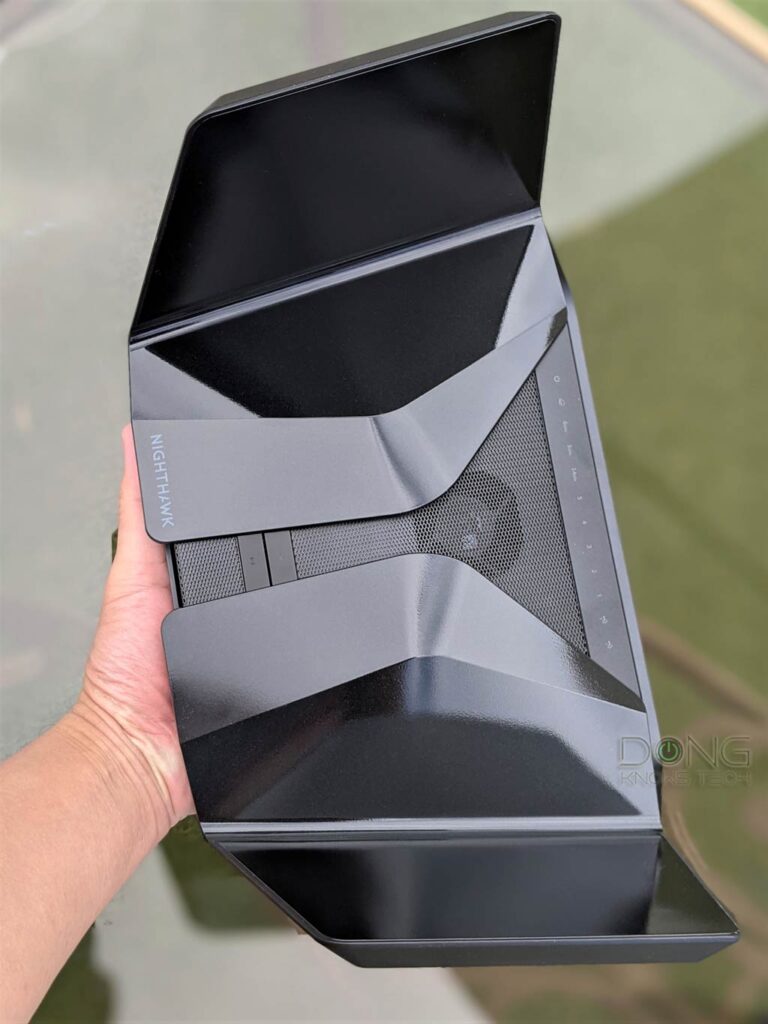
Wi-Fi signals (and speeds): A brief perspective
Before fixing anything, information technology'southward a good idea to understand how it works to a certain level — don't skip this part! Hither goes:
Betoken baloney and disconnection are part of radio transmission's nature. As the radio waves travel through the air, they meet many things that alter their integrity.

If you want to imagine how wireless transmissions occur, drop a pebble in a still pond, and lookout man the ripples movement outwards. That's your Wi-Fi signals — measured in Hertz.
At present, throw in another stone at a dissimilar spot. That's your neighbor's Wi-Fi signal. Toss a rubber duck in the water! That's your microwave. Run across what happens when the ripples collide? That'southward signal distortion — it's when your Wi-Fi drops.
What y'all might not have seen is that the pond was never entirely serene in the first place. And in that location were other things, like wind, insects, fish, the liquid'south viscosity, etc., already affecting the ripples created by the original pebble.
The point is: At any given fourth dimension, more things don't aid your Wi-Fi work as intended than those that do. And the fact it ends up working at all — delivering hundreds of megabits of data per 2d 24/seven — is already quite remarkable.
Merely information technology'south human nature to take things for granted. As Wi-Fi improves over the years, we've come to expect more out of it. Similar all things tech, in that location's more to Wi-Fi than what we can run into. And nosotros can't even come across it in the start place.
So set your expectations correct. There'southward no magic! Your Wi-Fi is never as fast as the vendor claims, and its speeds are ever going to fluctuate. And that'southward because your domicile, which is unlike from any other home, is not ideal for information technology in the kickoff place.
Wi-Fi dropping, disconnections, and failure to connect: The general causes
To accept proficient Wi-Fi, y'all first and foremost need the proper hardware. So get a router (or mesh system) that's suitable for your place and set it upward properly.
Hint: When possible, utilize network cables to link the pieces of your network together. Besides, if you get a cheap lemon, no amount of troubleshooting can assist — brand sure you invest in suitable hardware first.
Because you're on this website, though, I'd assume that you already got one of the all-time routers, which leaves us with iii other common reasons that cause your Wi-Fi betoken to driblet or are impossible for some devices to connect.
A. Hardware incompatibility
Incompatibility is probable the most common cause — equally mentioned above, Wi-Fi can be complicated.
There are and then many hardware vendors with lots and lots of devices. It's tough to keep all of them interoperating well in all scenarios. That's not to mention hardware and software quality and different Wi-Fi standards and tiers.
But at the core of information technology, this issue derives from the fact your broadcaster (router) and the client, like your laptop or IoT device, don't work well together due to incompatible hardware or software driver.
B. Point saturation or interferences
Point saturation is also typical, specially in urban environments. Simply look at your phone's Wi-Fi scan, and chances are you'll see a ton of available networks. Even though you have no access to most of those networks, they all are in your airspace, taking up precious spectrum allocation.
Then, the more Wi-Fi broadcasters of unlike types in the vicinity, the more likely you'll have to deal with signal interference. That's not to mention other types of devices (similar microwaves, cordless phones, etc.) that might as well utilise the aforementioned frequencies.
Interference: The curious case of Bluetooth
Bluetooth as well uses the 2.4GHz band. All the same, it'south very different and generally won't cause (much) interference.
The reason is Bluetooth is mostly for peer-to-peer and therefore doesn't require a fixed aqueduct. As a issue, information technology tin can "channel hop," –meaning it picks and chooses the virtually unoccupied channel to apply in real-fourth dimension. And it does that upwards to 1600 times per 2d.
Every bit a consequence, generally, Bluetooth doesn't affect Wi-Fi. Except in 2 instances:
- The 2.4GHz ring is fully saturated: Now, no hopping can assistance, only, well, chances are non-Bluetooth devices saturate information technology.
- Hardware sharing: This merely applies to clients. Many (older) Wi-Fi/Bluetooth combo chips don't piece of work well when both wireless functions are used simultaneously. This is rarely the case, if at all, with newer chips.
With that, it's safety to say Bluetooth devices don't cause Wi-Fi bug.
C. Other factors
There are other factors, too. Some of them you have no control over.
Examples are hardware issues, radar activities, thick walls, or even a jammer virtually your dwelling. Or the fact your home is made of materials that block radio waves.
Now that we have identified the issues, permit'due south observe out how to prepare them.
How to ready Wi-Fi dropping and connection issues
We can only fix what we have control over. Specifically, we by and large can't make changes to that radar station nearby — we but have to move — but at that place are tricks to handle hardware incompatibility and point conflicts/saturation.
At that place are 2 sides to a wireless connection, the broadcaster and the receiver. Each might accept issues of its ain.
Allow's get-go with the broadcaster since there are more things nosotros can practise on this end.
Wi-Fi dropping, failure to connect, and disconnection: What to do at the broadcaster (router) side
Your router is the heart of your Wi-Fi network. If something is incorrect with it, all devices in the business firm will endure.
Notes:
If it's not obvious, yous shouldn't cover your router — any broadcaster, for that matter. Don't fall for silly stuff similar Wi-Fi router protective cages! It'southward best to go out your Wi-Fi broadcaster out in the open.
Too, don't mess with the router's antennas — including using aluminum foil or silly stuff similar that. When applicable, keep those little poles opened up and in the vertical position and leave them lone.
0. Common house keeping you lot MUST do earlier anything
Make sure yous've taken care of the usual suspects, including stuff that seems obvious:
- Plug it in: That'south right, naught works without being plugged into power. Oh, you lot need to plow it on, too — some routers do have an on/off button for power or Wi-Fi.
- Restart: Yous should restart — non to exist confused with "reset" — your broadcaster once in a while, like once a month. Many routers allow you to schedule an automatic restart. In this case, it's a good thought to brand the router restart once a week — choice the fourth dimension when everyone is comatose! A restart takes no more than a few minutes simply volition crusade all devices to disconnect briefly.
- Latest firmware: Updating the firmware to the latest generally helps with security, compatibility, and performance. Running a dated firmware version is generally the master reason a router becomes unreliable as they get erstwhile. Some routers take an automatic update feature, consider turning information technology on. A firmware update might take upward to 10 minutes — again pick an advisable fourth dimension for it.
- Too much customization: If yous accept played with your router'southward setting too much willy-nilly, that tin can cause issues. I've seen folks blocking clients via their MAC address past mistake and so wonder why they can't connect. (Doh!). In this case, reset the router and set it up from scratch.
Also note:
- You have a router with a spider web user interface and are comfortable with the interface itself. (If you're using a router that only uses a mobile app and no web interface, your adventure of getting things fixed is minimal.)
- Support the router's settings to a file: You can reset and restore it to a previous state if you mess up. That happens.
With that out of the manner, allow's take a look at more specific things y'all can do. Notation that the listing beneath is in reversed order with the latest (and less mutual) issues on summit.
It'southward by and large a good idea to repower your Wi-Fi hardware once y'all accept applied the changes:
- Unplug it from the power
- Look ten seconds or longer
- Plug it dorsum in (and turn it on)
While this might not exist necessary in many cases, it's the only mode to make sure your new settings are in effect.
eleven. I take a mesh Wi-Fi system and some devices get disconnected or reconnected frequently at certain locations. Am I crazy?
No, you're not. This one is the mysterious, yet quite common, example where your Wi-Fi works well effectually the (large) firm, but some devices — more ofttimes those from Apple tree — become disconnected and reconnected at particular locations.
The brusque answer
Move your broadcasters (router or mesh satellites) around a chip, or arrange the dBm trigger when possible.
The long respond
When you use multiple broadcasters in a mesh system, the idea is that all of them broadcast a unmarried unified network so that devices tin get connected equally they roam effectually.
In reality, a Wi-Fi client withal has to jump from 1 broadcaster to some other. That'due south chosen seamless handoff or roaming assistance.
Handoff can be tricky since it depends on both the broadcasters and the device. Notwithstanding, when this occurs, the device will have a brief disconnection.
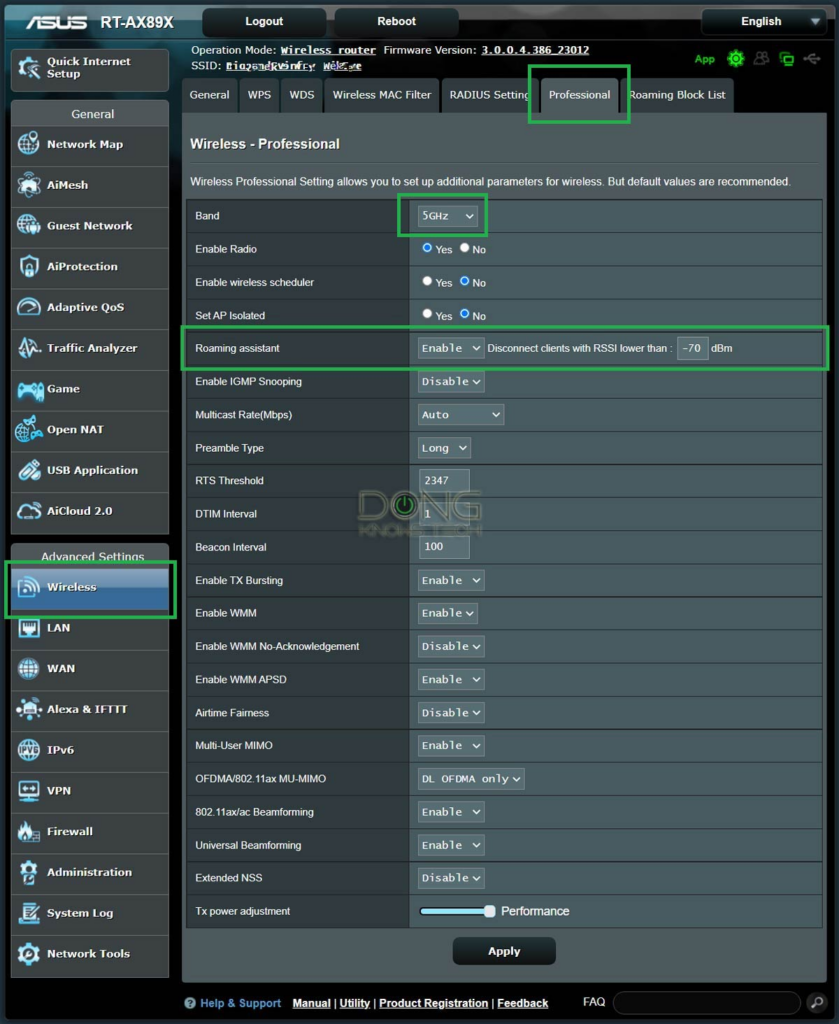
That's considering it needs to disconnect from the receding broadcaster so connect to another that's just gotten closer. What triggers the handoff is the preset level of dBm, a.grand.a the received signal forcefulness indicator — RSSI.
I detailed dBm in this post, but the gist is higher the value, the stronger the bespeak at which a customer would leap — it jumps more often. The lower the value, the more clingy the client is to its current broadcaster — it might stay connected at a slow speed.
If you take the dBm trigger at a certain setting and have the device right betwixt 2 every bit powerful broadcasters, it might jump regularly, and that will cause disconnections.
The real consequence is there's no concrete solution for this because it's nuanced. Nonetheless, changing the dBm trigger value sure will make a difference.
In specific mesh systems, such as Asus's AiMesh y'all tin change this dBm value fairly hands. With those that don't let yous to exercise that, moving the broadcasters around, sometimes just by a foot or so, will do the flim-flam.
Past the way, for more tips on setting up a Wi-Fi network, check out this post on how to get the most out of your Wi-Fi.
10. I have Gigabit Internet and only upgraded to a top-of-the-line Wi-Fi vi router, but my phone can't connect faster than 350Mbps. Why?
This is another assumption like the case of question number viii below. A connection's speed is that of the lowest party involved.
The short respond
Become a new phone. Or just stop speed-testing already.
The long answer
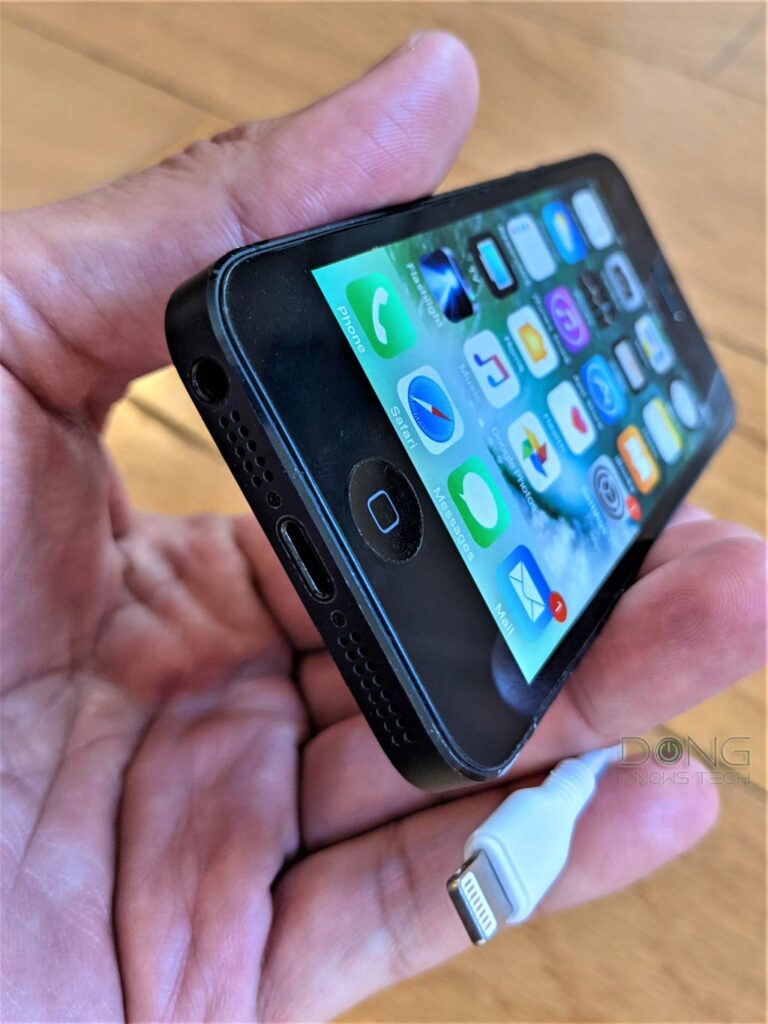
I wrote a long piece on Wi-Fi and Cyberspace testing, but the gist is this: The router and your phone are 2 dissimilar things. Upgrading one doesn't hateful the other is automatically up to snuff.
Nearly importantly, our telephone doesn't need to connect at super fast speed, either. And 350Mbps is speedier than whatever awarding would require.
nine. My 2.4GHz devices accept a hard time staying connected or connect at slow speeds?
This is a relatively rare case when the ii.4GHz ring performs at extremely tiresome speeds, even when yous get out the device close to the router.
Again, nosotros talk extreme hither since this band, by nature, is slow. And so be concerned if you can only connect at around 15Mbps or slower.
The brusque respond
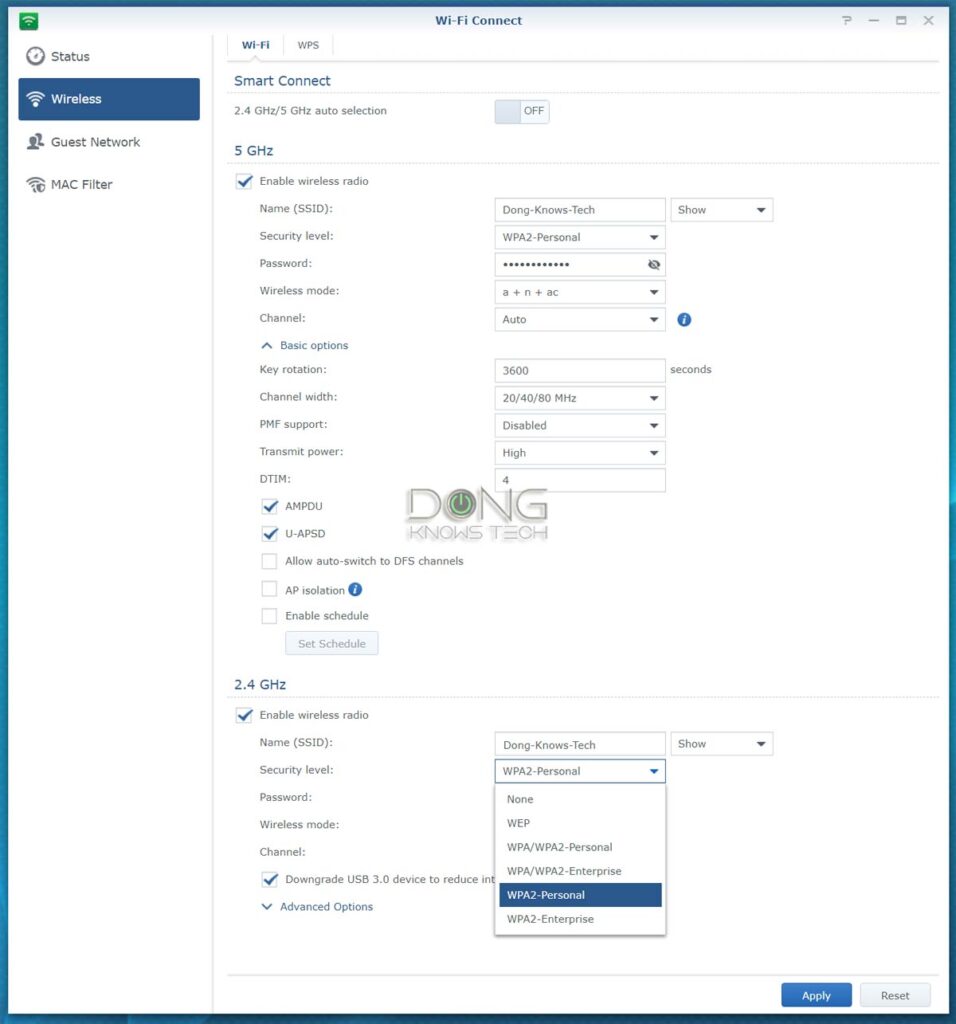
Switch the router's USB 3.0 port to USB 2.0 mode when applicable. Or remove the connected USB device from it.
The long respond
This applies only to routers with a USB 3.0 port and allows you lot to manage this port's speed.
In many cases, using the router's USB port in the fast USB 3.0 standard (5Gbps) causes agin effects on the router's 2.4GHz Wi-Fi ring.
I've experienced this in routers from Asus and Synology, but the consequence might be more prevalent.
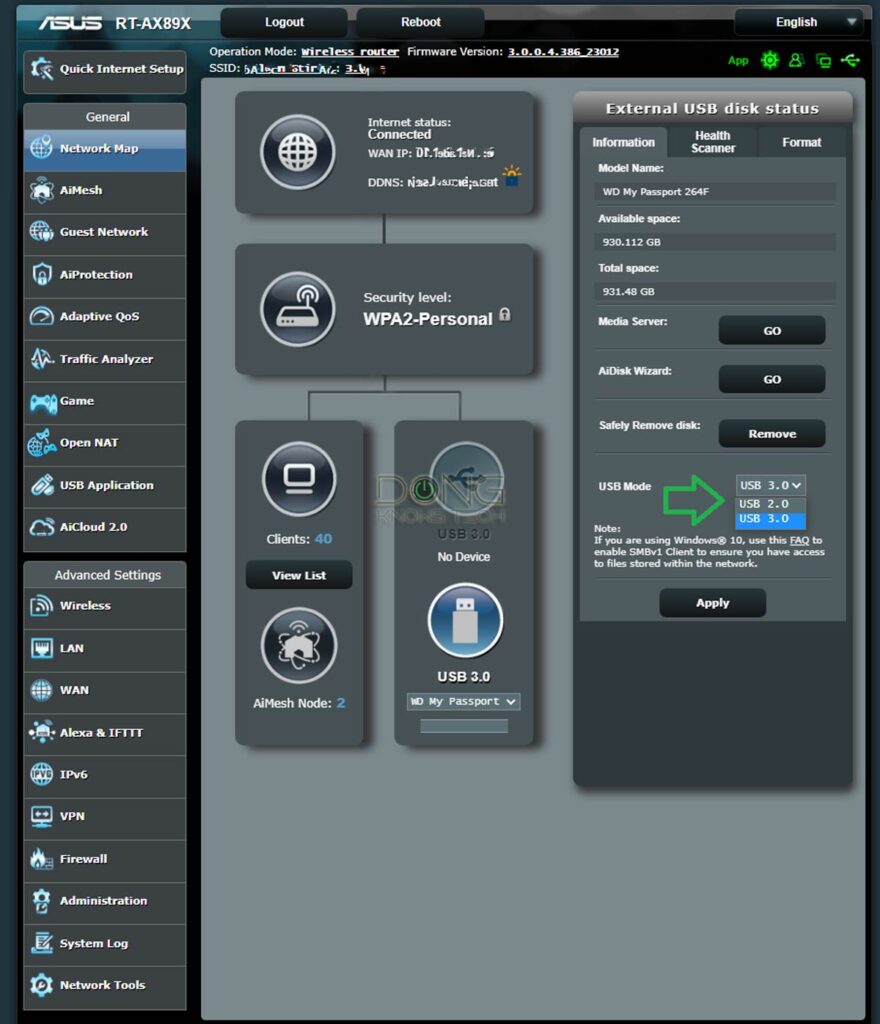
The solution: Use the USB port in USB ii.0 manner, which caps at just 480Mbps. You generally can exercise this within the router'due south web interface, either at the USB or 2.4GHz Wi-Fi section.
Past the way, you might need to plug a portable drive into the port before it's possible to make the change.
Conspicuously, this setting is not ideal for those using the router as a mini NAS server since the NAS speed volition be ho-hum. Only that's just an example of how we can't have everything.
8. I simply got a brand-new tiptop-tier Wi-Fi router, merely my Net speed doesn't improve at all. Why?
I got this question a lot. Folks get a new and exciting Wi-Fi router and automatically look their Internet to exist faster. Specifically, they desire it to lucifer the new Wi-Fi speed.
The brusque respond
It'southward likely your Internet. Wi-Fi tin can't increase your Cyberspace speed automatically — simply your service provider can.
The long respond
Internet and Wi-Fi are two dissimilar things. If y'all have slow broadband, no Wi-Fi can go far faster.
However, in this case, proper QoS configurations will likely help. Too, reduce the number of smart devices, especially cloud-based security cameras, to free upwardly the upload pipe.
Note, though, using QoS can make your Net speed seem slower in a speed test.
seven. Fast Cyberspace at the modem (or ONT) but slow via Wi-Fi or even when wired to the router?
This broadband speed discrepancy has been increasingly common as Gigabit-form, Gig+, or even faster Internet admission become more popular. Here's the scenario:
When using the same (wired) client, you get fast Internet directly to the modem (or the fiber-optic ONT) but not via the router.
The short answer
Check your client'southward speed grade, router'due south bandwidth control, QoS, MTU, and Jumbo Frame, and brand sure their settings are applicable.
The long answer
Assuming yous already have an first-class router, this can be a complicated outcome since. In this case, a couple of things to try in this order:
- Turn off, or the re-tune, the QoS setting on the router. QoS is an Net regulating feature and as such it might slow down the broadband speed depending on the application. In whatsoever case, remember that QoS is not intended to make your Cyberspace faster.
- Make sure that the client you use for testing is the just i using the Internet. That's considering the bandwidth is shared.
- The router must have a fast WAN port. Information technology has to be one of those Multi-Gig-ready routers.
- The Wi-Fi (or wired) connection between the router and the client has certain cap speeds. The bespeak is that the connectedness between the router and the client must exist the aforementioned or faster than between the router and the Internet. And then:
- If that's a wired connection, brand certain it'south Gigabit or faster. Clearly, it has to be the same speed form equally your broadband.
- If that's a Wi-Fi connection, continue in mind that ii.4Gbps negotiated is the best you can get for now (real-world speed is much discounted) if y'all use Wi-Fi 6/E. If you have Wi-Fi 5, the general speed is around 800Mbps.
Extra: Colossal Frame or MTU settings tin exist the real fix for a Gig+ and faster network
If Jumbo Frame and MTU sound foreign to you, that's considering they are non meant to exist popular settings. And for good reasons.
However, in many cases, enabling Colossal Frame or setting the MTU to the optimal value is the last crucial step in getting the best connection speeds.
You can find details on how to do that in this post virtually handling MTU and Colossal Frame.
6. A (new) device can't re/connect to Wi-Fi?
Assuming you're non blocking the device by mistake, this is likely the issue with the IP address pool.
The short answer
Make sure the IP address pool is large enough. Generally, information technology'due south better to have the pool significantly larger than your total number of devices.
The long answer
By default, well-nigh routers (or mesh system) limit their IP address pool to take no more than than a certain number of clients, like 25, 30, or 50 — much lower than the full number of IP addresses whatsoever router can requite out, which is 253.
While it's a practiced idea to have fewer agile clients, it'south OK to make the address pool much larger than the number of devices a router can handle. That's because not all clients are active at all times.
Besides, sometimes, one device might use more than one IP address for various reasons. So the pool limit can run out earlier than you expect, causing new or returning clients to fail to connect.
That said, it's generally a skilful idea to gear up the IP puddle limit significantly higher than the number of devices you want to use. For more on IP puddle and the detailed steps to change that, check out this post on all things router-related.
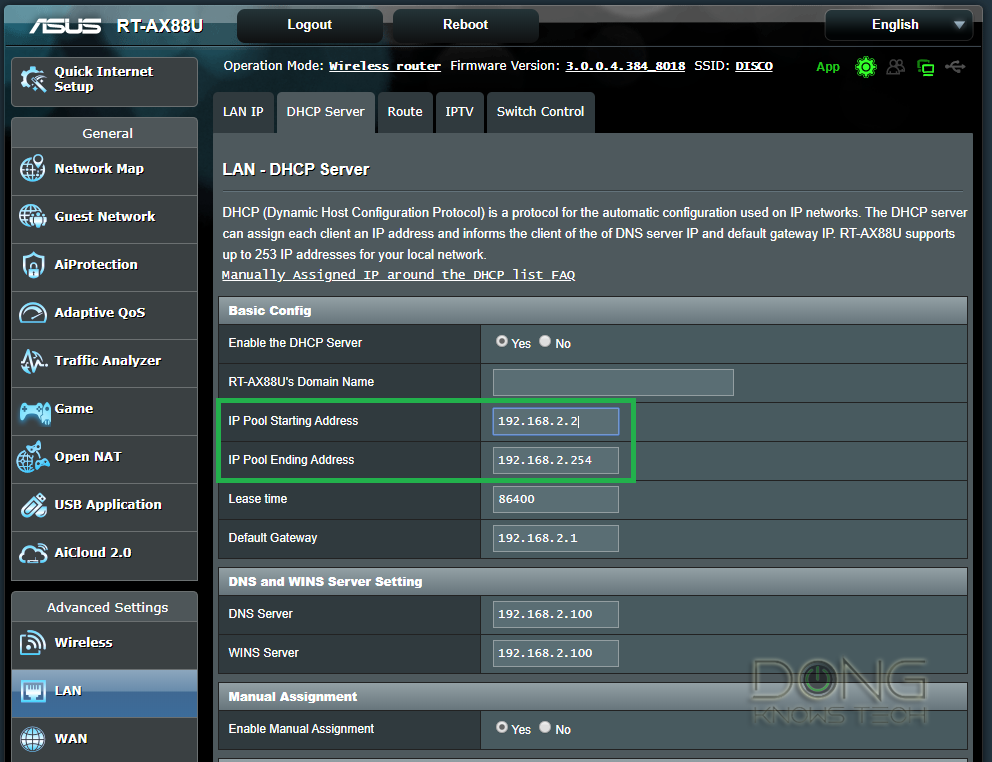
Extra: IP lease time and you
Every bit you lot can encounter on the screenshot higher up (below the IP pool), the IP lease fourth dimension is the window of fourth dimension the router will keep an IP for a particular device — even the device is not connected. The IP volition not be available to any other client during this period.
This period starts when the device outset connects and won't change until it runs out unless y'all restart the router earlier that, which volition crusade all devices to reconnect with a new lease.
The lease time is used in seconds, and past default, most routers utilize the 86400 value (24 hours). And that'due south fine for most home use. But if you have an environment where you desire the IP to become available immediately, you tin reduce that to an 60 minutes or 2.
When the charter runs out, the client will need to reconnect and become a new IP. This process takes a cursory second and requires the router and client to negotiate, then it's not a good idea to keep the lease as well short.
5. Internet of Things (IoT) smart Wi-Fi devices or legacy devices can't connect to Wi-Fi?
First of all, when it comes to IoT devices, just because they accept "smart" on their proper noun doesn't mean information technology'south a smart affair to utilise them. I'g talking well-nigh devices that connect to your Wi-Fi network directly.
By the way, this is the supplement to tip #2 below.
The curt answer
Don't get inexpensive smart devices, particularly those from unknown vendors. After that, use a uncomplicated SSID (Wi-Fi proper name) and password.
The long respond
In my experience, most smart Wi-Fi devices are terrible and prone to security — that's near e'er the case if you buy a cheap one of unknown brands.
But even when you purchase ane from a reputable company, keep in listen that these devices have the depression processing power, so they use minimum specs of Wi-Fi.
As a result, the broadcaster (router) needs to piece of work in a mode that supports the lowest denomination of clients, which is slow. In other words, having these devices in the dwelling might adversely affect the performance of your entire Wi-Fi network.
So my offset advice is to avoid them. Just if, for some reason, you withal want to use these devices, the following fox might help.
Uncomplicated SSID
In my experience, the complexity of a Wi-Fi network's name (SSID) and password tin can be the reason why some clients — specially IoT devices — can't connect to it.
That said, here are the rules in making your Wi-Fi network'southward proper name:
- Use plain English messages
- Avert using special characters or spaces
- Keep it brusque
For example, instead of using a name like "Dong Knows Tech," or even worse, "Đông Knows Tech ⚡," option "Dong-Knows-Tech" or, better yet, just "DKT." (Needless to say, the quotes are not office of the names.)
Digit-only password
As for the password, information technology's best to use a long string of numbers. You tin make information technology long and random, and then it'south difficult to guess.
Tips on Wi-Fi passwords
When it comes to passwords, it'south always about keeping it a secret that matters. Don't associate complexity with security.
The goal is to make your password hard to approximate but easy for you lot to remember and use. Your password shouldn't exist so circuitous that y'all'd have a hard time using it.
A Wi-Fi countersign that includes letters, numbers, and special characters, can be a hurting to employ, especially when you demand to enter information technology into an IoT device. Consider a digit-but countersign.
Here'due south one of many ways to make a digit-only password random and easy to recall:
Pick a long sentence and apply each give-and-take'southward letter of the alphabet count to form the password.
That'd be 414833545652438 if you lot use the previous sentence — use your own.
Separate SSID
If you need to utilize a fancy name and password for your Wi-Fi for ane reason or another, you tin create a separate simple Wi-Fi network just for the devices that can't connect to the fancy one.
In this case, you tin can make a Guest network for this purpose — make sure yous turn on the intranet access for it. Or y'all can even get an additional access point to utilise exclusively for IoT and smart home Wi-Fi devices.
By the way, many IoT devices only work with the 2.4GHz band, so make sure you turn this band on and utilise the name and countersign rules above.
4. Network printers, IP cameras, etc., get disconnected sporadically?
This is the curious instance when those devices work fine when you first set up them upward, but later a while, you tin can't use them fifty-fifty and then those they remain connected — as y'all can run across that on their screen or status.
The short reply
Reserve their IP addresses. In other words, you want to make sure they connect to the network using the aforementioned IP every fourth dimension.
The long answer
This issue happens in all devices that use the IP address as the only way to identify itself in the network — modern devices employ something else to avert this result.
Just this issue will happen in all applications where a fixed IP address is required. Examples are VPN server (or any server type) or remote assistants.
In this case, when its IP changes — ofttimes when you restart the router or the device itself — the device now appears as a new 1, causing the remainder of the network to no longer run across it equally what it used to exist.
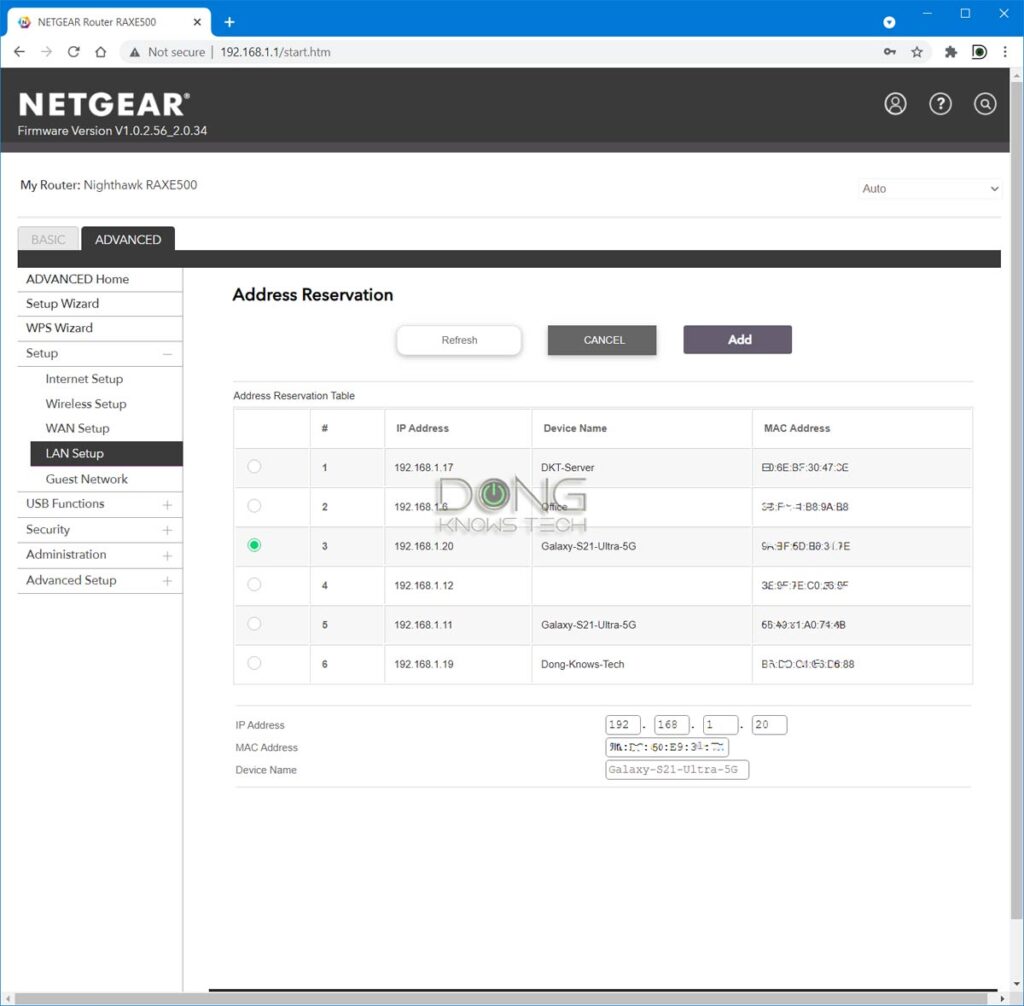
To keep this from happening, you need to reserve an IP address for the device in question to make sure it has the same IP at all times. IP reservation means you "bind" a particular IP address with the device's unique MAC address.
Observe out more about IP addresses and specific steps on performing IP reserving in this post.
On this IP reservation topic, note you can't do that with most, if not all, Wi-Fi extenders. That'southward because they automatically give out virtual MAC addresses to their clients.
That said, if you lot demand IP reservations, finish using extenders in your dwelling or connect the device in question straight to the router.
3. Intermittent Wi-Fi disconnections on high-finish/new devices?
This upshot applies to those with a high-stop Wi-Fi 6 router who experience intermittent brief disconnections seemingly out of the blue.
This is probable because the router works in the 160MHz aqueduct width, which is required for the top performance.
The brusque answer
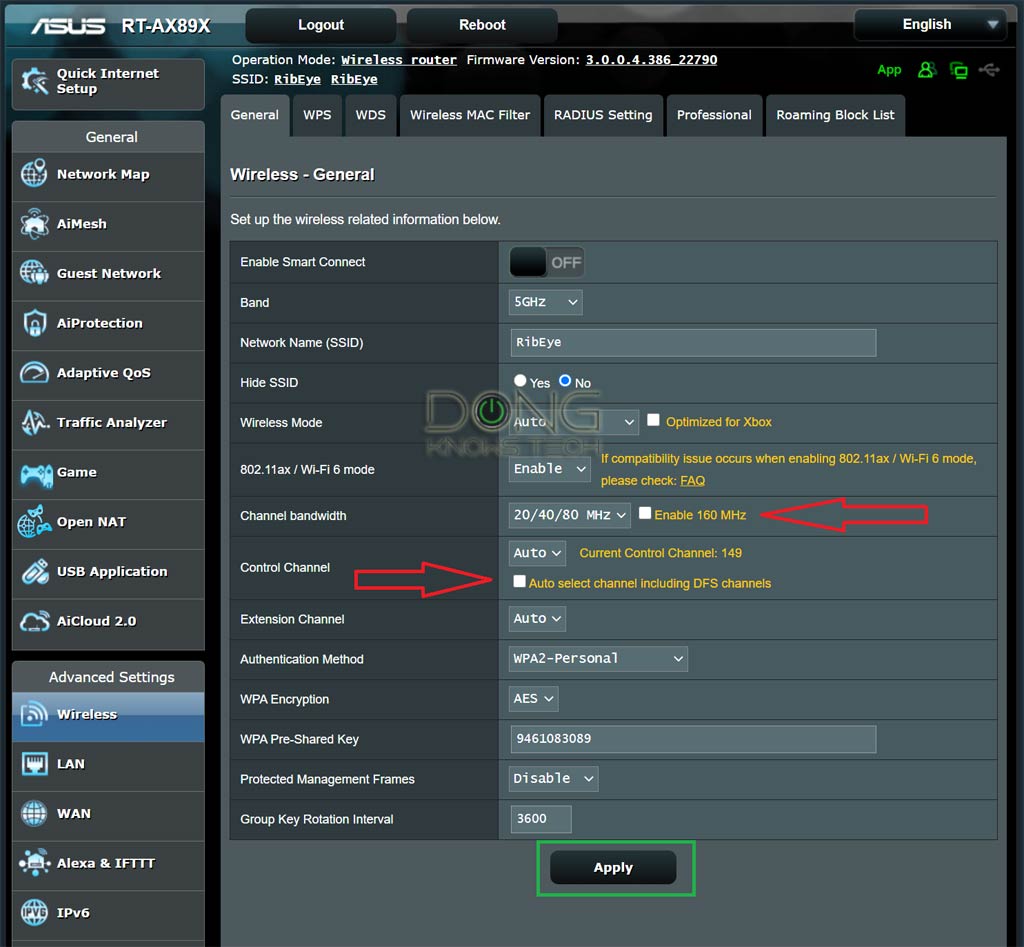
Avoid Dynamic Frequency Selection (DFS) channels and apply the router in 80MHz channel width. You tin cull to turn off the 160MHz width and apply the router in the Auto setting.
The long answer
DFS shares its airspace with radar and, by regulations, takes the back seat. Consequently, a router automatically switches its DFS channels to a free 1 when radar signals are detected.
Clients will experience a cursory disconnection that lasts from a few seconds to even a infinitesimal when this happens. It'south a dilemma since DFS channels are necessary for summit Wi-Fi vi speeds.
Depending on how frequent radar signals are present, y'all might not even notice the disconnection at all. Just if that happens when you're in the middle of a existent-time advice app, like video conferencing, or online gaming, it sure is a pain.
That said, if you live close to a radar station — within tens of miles — information technology's a good idea not to use DFS channels. Note that all airports accept radar, and almost every city has a conditions radar station.
Extra: How to not use DFS channels
How we handle DFS depends on the router — some don't support DFS at all. Mostly, you can make the router ignore all DFS channels or manually pick one not part of the DFS spectrum.
Before you lot can exercise that, though, note that DFS is only available in the 5GHz frequency band. And then get-go, you might demand to dissever it from the ii.4GHz — turn off Smart Connect, that is — before yous can make specific changes.
After that, keep in mind that the 160MHz channel width requires DFS, then don't use it.
Finally, DFS ranges from channel 52 to 144. That means channels outside this range, including 36, 40, 44, 48, 149, 153, 157, 161, and 165, are not function of this particular spectrum. Ensure your router (and the backhaul link if you take a wireless mesh system) uses one of those.
ii. Many (legacy) devices can't connect to Wi-Fi?
This outcome happens when you upgrade your router to a newer standard. Existing clients might non be ready for it.
By the way, on this front, also check out what you tin do on the customer itself below.
The brusque reply
Change the router's Wi-Fi settings to favor compatibility. Yous can likewise consider separating its bands (5GHz and two.4GHz) as different SSIDs (Wi-Fi network).
The long reply
Though all Wi-Fi standards are supposedly astern compatible, the devil is in the details.
That said, if you take a lot of legacy clients, such as Wi-Fi 4 or the first-gen Wi-Fi 5, and go a new Wi-Fi half-dozen/E router, you might run into issues if y'all insist on making your router perform at its superlative speeds.
In this case, it's a expert idea to make the (new) router friendly with older clients. (More than on how to better this on a client below).
More often than not, you can practise this in the Wi-Fi or Wireless section of the router's interface. There are 2 things two consider: compatible Wi-Fi settings and band separation.
Compatible Wi-Fi settings
Note that there are many Wi-Fi settings, and some routers might give you lot more than others. Too, any of the following items alone might exist plenty to fix the problem. So, try them out one at a time.
- Wireless Mode: Utilize Mixed or Automobile. If yous selection a specific standard like 802.11ac (Wi-Fi 5) or 802.11ax (Wi-Fi 6), clients of different standards won't be supported.
- Aqueduct width: Choose the value that allows for all available bandwidths, including 20MHz, 40MHz, 80MHz, and 160MHz. If you pick only one value, the higher the number you lot select here, the fewer clients are supported. The settings that include all of the available aqueduct widths are the most compatible. (More on the 160MHz and DFS aqueduct below.)
- Security level: The level that'due south balanced betwixt security and compatibility, for at present, is WPA2/WPA3. If you utilise WPA3 only, many clients won't be able to connect. But if you lot pick WPA or lower level, your network is more susceptible to hacking. It would be best if y'all stopped using clients that require fifty-fifty less secure methods (WEP).
- 802.11ax HE frame support: Available in some routers; this setting favors performance for Wi-Fi 6 clients. If you take a lot of Wi-Fi 5 and older devices, you should plow information technology off.
- Plough on Extended NSS: Non available in all routers, but if yours supports it, information technology's in the avant-garde/professional area. Too, it's probable already turned on by default.
- Smart Connect (when available): This setting combines the 2.4GHz and 5GHz bands into a single Wi-Fi network. Information technology doesn't necessarily better compatibility, but it helps keep your connection consequent since clients can automatically switch betwixt the two.
Separate the bands
This setting is the opposite of item #6 above. I know this is confusing, but it's best to separate each band of a broadcaster into a Wi-Fi network (SSID) of its ain in certain situations.
It applies to:
- You have older or single-stream (5GHz or 2.4GHz) clients.
- You have a tri-band broadcaster that has two unlike 5GHz bands (Wi-Fi v vs Wi-Fi 6), like the Asus RT-AX92U or AmpliFi Alien.
- Yous have a traditional tri-band router and want to apply one of its two 5GHz bands in the compatibility mode and the other in performance fashion.
- You want to have complete control of which band a client or a group of clients should apply. For example, y'all can brand the ii.4GHz for low-bandwidth IoT devices, and 5GHz for high-end gaming rigs.
By the way, if you use a tri-band wireless mesh, set the backhaul band to be the fastest supported by the satellites. There's no need to worry about compatibility with this band — it works exclusively for the satellites anyway.
1. What's the most important Wi-Fi setting for best connection speeds? The channel
There's no short answer to this.
A Wi-Fi router has three things to fulfill at any given time: The best connexion speed, the about extensive coverage, and the highest client compatibility. The last one is about important since the get-go two are irrelevant if a customer can't connect.
Only all three are handled with nuances. That said, the most crucial Wi-Fi setting is likely to pick the right aqueduct. By default, most routers utilize the "Auto" setting, which means the router itself will determine the best channel based on the existent-world condition.
And nigh of the time, that works out. If you accept a standalone router, that might be all y'all accept to exercise.
However, a router can only detect the point at its location, not throughout the entire dwelling. As a issue, all can be fine when you're near, just as you move farther out, your device may start disconnecting intermittently.
The disconnection often happens when you use a mesh organisation with multiple broadcasters at different places around your abode. To improve the situation, pick a channel that's used the least, on average, throughout your area of desired Wi-Fi coverage.
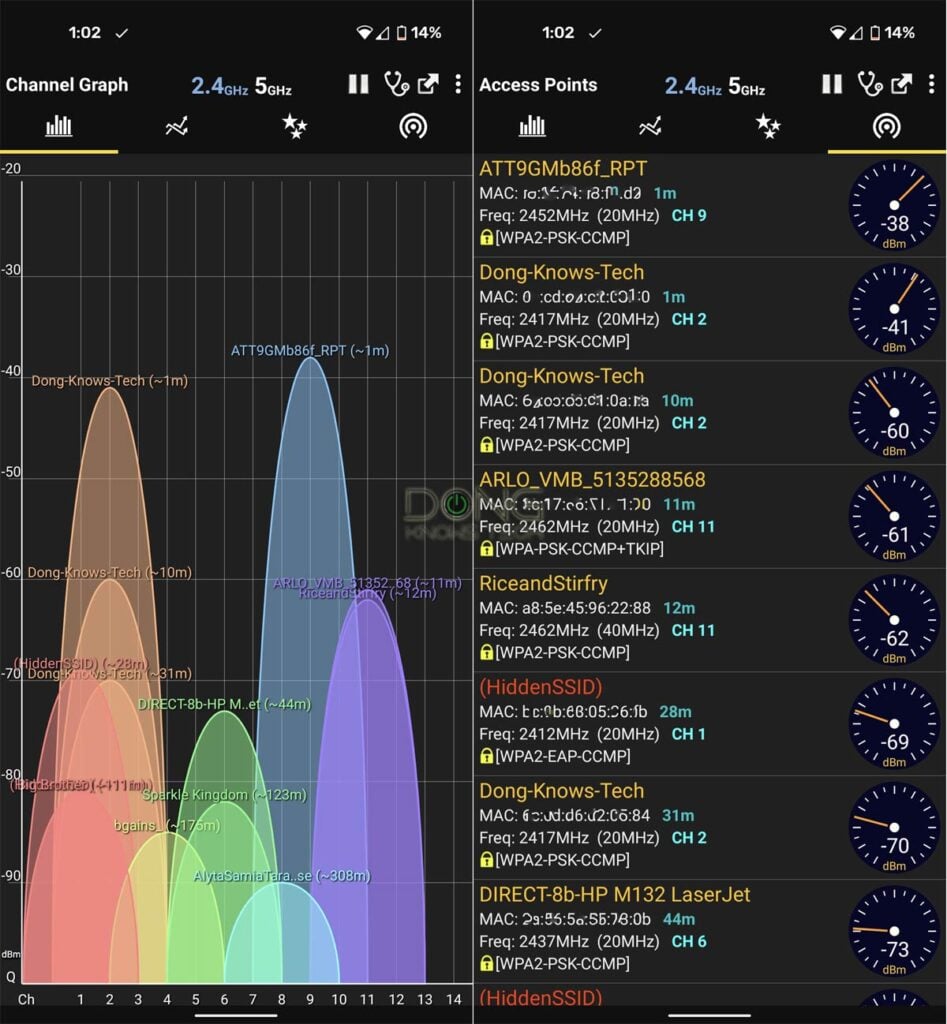
Here'south how: Become a gratis Wi-Fi analyzing app to site-survey the airspace as you walk effectually. You'll be able to "view" the channels in real-time. You'll note that a channel might exist completely free at one spot, wholly used at another, and lightly used at another.
Pick the ane that'south used the least on average. Practise that for all the router's bands involved. By the manner, in a mesh system, the primary router and the satellite(southward) will share the same Wi-Fi aqueduct for each band.
(By the way, to understand the Wi-Fi signal strength and usage, you demand to know the value of dBm. I explained dBm in item in this post, merely the gist is yous're dealing with a negative number, so the lower the value, the meliorate the signal is.)
And that's it. Now cantankerous your finger and apply the changes to the router when applicative. Hopefully, things are all good now. If not, it's time to cheque on your clients.
Wi-Fi dropping or disconnection repair: What to do the client
There are two things nigh the clients, the customer itself and the software driver.
Client'south Wi-Fi settings, physical condition, and protective case
That said, check the customer. Is information technology physically intact? If you have dropped it, that could have caused some hardware parts not to function correctly, and the Wi-Fi adapter might be amidst those.
Over again, cheque to make sure yous haven't turned off the Wi-Fi (Plane mode) or manually ready its Wi-Fi to work in a certain manner — go out the settings at default unless yous know what you lot're doing.
If you utilise a phone or tablet, proceed in heed its protective example adversely affects the wireless reception. All phone cases practise — it'southward a matter of caste. The more "protective" the example is, the worse it gets.
Software drivers
Y'all need the latest Wi-Fi driver for each customer to work well. The driver is software that allows a hardware component to work with the operating system.
If you're on a Mac, you'll need to upgrade your computer to the latest version of macOS and also the latest of any is offered via Mac Software Update. That'southward how you can keep your Wi-Fi driver updated. In that location'south no other manner.
On a Windows figurer or a mobile device, you can do a few other things. (By the way, if y'all're using the Intel AX210 Wi-Fi 6E adapter, you might desire to upgrade your computer to Windows eleven or apply this detail driver for Windows 10.)
How to upgrade Wi-Fi commuter on a Windows calculator
In Windows 10, you tin cheque on the driver of the Wi-Fi adapter the same way you do whatsoever other hardware components. Hither'south how:
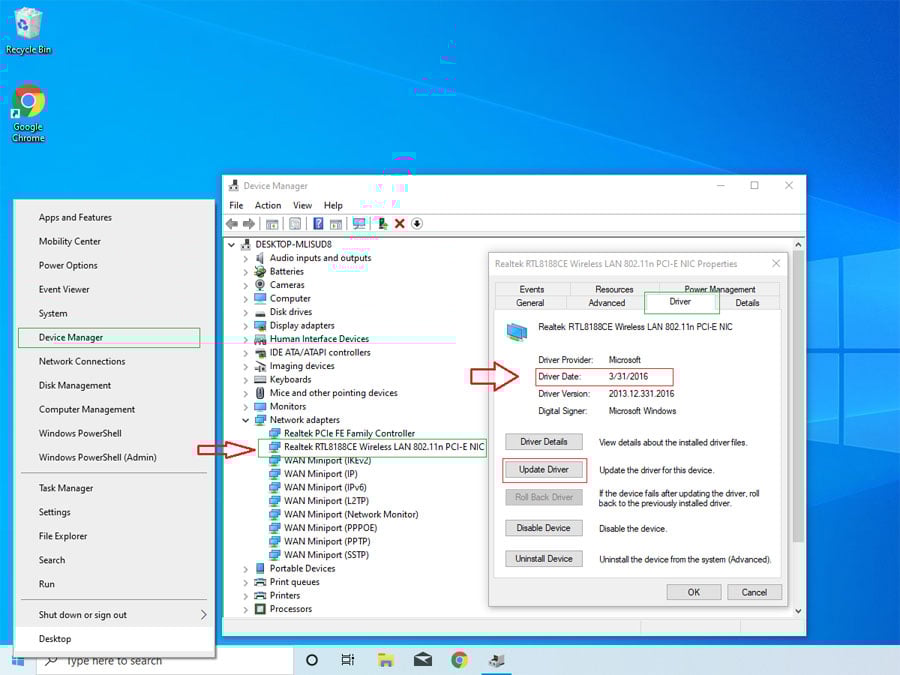
1. Right-click on the Start button (lower-left corner) to bring upwardly the Windows X bill of fare. (I call it the "Windows Ten" menu because you can also call it upward using the Windows + X keyboard combo.)
ii. On the card that pops up, click on the Device Managing director item to bring upward its window.
3. On the Device Manager window, navigate to a hardware component in question. In this case, it'south ane of the Network adapters. Pick the Wi-Fi adapter, and double click on it to bring upwards the Backdrop window of that device.
4 On the Properties window, click on the Commuter tab to expect at the Driver Engagement value.
For a Wi-Fi adapter, the commuter's release date shouldn't be earlier 2019. If so, information technology'south too old, and you want to try updating the driver. To practice that, click on the Update Driver button, then on Search automatically for updated driver software.
If in that location'south a new driver available, information technology'll exist downloaded and installed automatically. Alternatively, you lot can also check the manufacturer's website to meet if in that location is a new driver. Download it and install information technology manually, equally I detailed in this post on Wi-Fi 6E commuter.
If there's no driver update and the computer'due south Wi-Fi doesn't work with your new router, fifty-fifty after y'all have done all the router-related tricks above, well, you lot're out of luck. It's time to remember almost replacing that Wi-Fi adapter or the host device entirely.
How to fix Wi-Fi dropping issue on a mobile device: Latest updates and reset
Yous can't update only the Wi-Fi software driver on a mobile device. The only way to update anything is to wait for the update pushed out by the manufacturer.
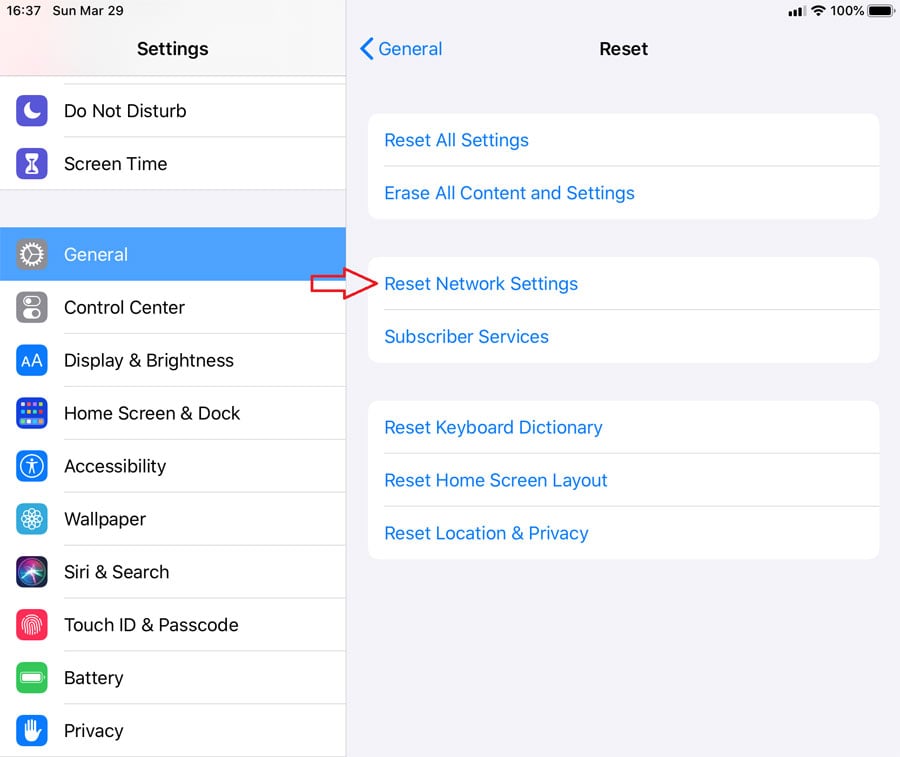
All the same, in that location are ways to set your mobile device, particularly an iDevice, from Wi-Fi dropping issues, without getting any update.
Tips
If y'all take an Apple tree device, including a computer, and its Wi-Fi connection starts acting upwards after an Bone/Software update when connecting to the same router, which has no trouble with your other devices, here's an easy way to likely fix the issue:
Remove your Wi-Fi network from the device in question and re-add together it like information technology'due south a new network. This will remove any actress erroneous settings caused by updates.
Hither are a few general things to try — whatever of them might gear up the problem, and so try i at a time.
- Restart your device: When did yous restart your telephone? Exactly! It'southward a good idea to close all open apps and perform a restart in one case in a while. That can solve a lot of problems, including those relating to Wi-Fi (and cellular) connection.
- Update your device to the latest Bone version and patches: This is especially true with incremental updates, which tend to include the latest drivers. The update process volition as well restart your device, past the way.
- Reset the network setting: This volition erase all saved Wi-Fi networks, and yous will need to enter them again. However, information technology also removes all wrong settings that might cause connection issues. You lot can find the Wi-Fi or Network reset in the device's Full general Settings area, or yous can search for it.
- Reset the device to default: This will erase everything you lot take on the device, so make a backup first. This desperate stride helps refresh your equipment and make it work like new, at its optimal land, including the best possible Wi-Fi support.
The takeaway
Wi-Fi is a lot more complicated than wired networking. For one, it's invisible. You can't see what causes interruptions in the radio waves. So knowing what has gone wrong could be a challenge.
That said, proper hardware setup on the router and using clients with the latest software are the key to a well-performing wireless network. Besides that, brand sure you selection the best setting for your item state of affairs and environment — you lot're already there.
About chiefly, don't expect magic! Have some time and capeesh how the engineering has worked for you. A little Wi-Fi dropping and disconnection here and there is a small price to pay for so much gain you've been getting out of it.
Source: https://dongknows.com/how-to-fix-wi-fi-dropping-and-disconnection-issues/
0 Response to "Rt-ac1900p Please Try Again After 5 Minutes Error"
Post a Comment